According to the Scheme of Amalgamation, shareholders of Vijaya Bank will get 402 equity shares of BoB for every 1,000 shares held. In the case of Dena Bank, its shareholders will get 110 shares for every 1,000 shares of BoB.

Since March 31, 2022, the PSBs' market cap has risen 43.7 per cent, from Rs. 7.29 trillion to Rs. 10.47 trillion. It's time for the government, the majority owner of public sector banks, to reap the benefit of the rally in bank stocks, recommends Tamal Bandyopadhyay.

Unlike any other business, banking is a turf where the captain's role is the most critical. Often a bank is defined by the personality of the CEO who runs it. Both HDFC Bank and Kotak Mahindra Bank are the creation of their CEOs, notes Tamal Bandyopadhyay.
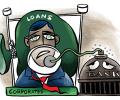
This is following revival of demand from the corporate sector and small and medium enterprises (SMEs), even as a nascent economic recovery is taking shape. Credit growth of scheduled commercial banks had accelerated to 9.2 per cent year-on-year (YoY) by the end of December 2021 after breaching the 7 per cent-mark in November, for the first time since April 2020.

Vijaya Bank assured employees that the service conditions 'will remain unaffected and staff benefits retained'

'We should look at is full year's growth rather than quarter numbers.'

Collectively, the pack of 12 has posted a 50 per cent rise in profits -- Rs 25,685 crore. On a quarter-on-quarter basis (that is, September over June), the rise is 68 per cent. Public sector banks have never had such a stellar performance, explains Tamal Bandyopadhyay.

Country's biggest mortgage lender HDFC on Tuesday announced a festive offer in line with peers like SBI with home loans starting from 6.70 per cent. Last week, SBI as part of festival bonanza offered a concessional home loan rate of 6.70 per cent under its festive offer. This was followed by other lenders like Punjab National Bank and Bank of Baroda.

Ketan Parekh, an accused in several cases of stock market manipulation, has been convicted by a special CBI court in Mumbai for cheating and sentenced to two years rigorous imprisonment.

Start-ups Zomato, PB Fintech, One97 Communications, and FSN E-Commerce Ventures have entered the large-cap category after the latest reclassification exercise by the Association of Mutual funds in India (Amfi). This comes despite stocks such as PB Fintech (Policybazaar) and One 97 Communication (Paytm) trading below their issue price. Others such as Mindtree, SRF, IRCTC, Tata Power, JSW Energy have been moved from mid-cap to large-cap category.

Reliance Industries (RIL) is likely to be the lone bidder for Mangalore-based JBF Petrochemicals, which is up for sale after defaulting on bank loans worth Rs 5,000 crore. The lenders for the second time extended the deadline for submission of bids, which had ended on August 20, as several players, including public sector companies, were redrawing their acquisition plans, said people in the know. "There were several companies which had submitted their expressions of interest (EoIs) for the company but after due diligence decided to exit the race," said a source close to the development. "The new deadline for submitting financial offers is August-end," the source said.

Exuding confidence in sustaining the tempo of credit growth, public sector bankers said on Wednesday that consolidation in the public sector bank (PSB) space has given them a robust base to scale. The privatisation of PSBs can be done through divestment of government stake to a wider base of investors without haste. There is nothing to worry about at this point (high credit offtake) as underwriting standards and risk management are much better.
Public sector banks have raked in more profits in the three months ended June on the back of a persistent decline in bad loans and the trend may have a positive bearing on their balance sheets in the coming quarters. In the June quarter, Bank of Maharashtra (BoM) and State Bank of India (SBI) were in the lowest quartile as far as Gross Non Performing Assets (NPAs) and net NPAs were concerned, according to an analysis of the quarterly financial numbers published by the public sector lenders. Cumulatively, all the 12 public sector banks reported a profit of about Rs 15,306 crore in the three months ended June, registering an annual growth of 9.2 per cent. However, leading public sector lenders -- SBI and PNB -- posted lower profits in the June quarter.

YES Bank, Bank of Baroda, SBI, IndusInd Bank, and RBL Bank are amongst the banks, Jefferies says, are most prune to "high risk" emanating from ADAG, Cox & Kings, CG Power, DHFL and Essar Shipping.

The Reserve Bank's rate-setting panel will start its 3-day deliberations on Wednesday amid expectations of yet another rate hike of 50 basis points to check high inflation, in line with similar actions taken by other major central banks, including the US Fed. Based on the recommendations of the Monetary Policy Committee (MPC), the RBI had effected 50 basis points increase in repo rate each in June and August after raising the short-term lending rate by 40 basis points in an off-cycle decision in May. The MPC, headed by RBI Governor Shaktikanta Das, is scheduled to meet during September 28-30.

A lot depends on how Srei shapes up under the new administrator and his team, which is critical for investors' interest.
Days after the US Fed raised the interest rate, the RBI may go in for its third consecutive policy rate hike by at least 35 basis points to check high retail inflation, experts said. The central bank has already announced to gradually withdraw its accommodative monetary policy stance. The Reserve Bank of India's rate-setting panel -- the Monetary Policy Committee -- will meet for three days from August 3 to deliberate on the prevailing economic situation and announce its bi-monthly review on Friday.

According to a complaint from Bank of Baroda, the conspirators allegedly cheated a consortium of bank loans of Rs 3,695 crore. The scam was earlier estimated at around Rs 800 crore.

A depreciating rupee, which briefly hit 80 to the dollar on Tuesday, may boost India's exports but price-inelastic imports of crude oil and gold would mean limited relief on the trade deficit, which clocked a record $26.2 billion in June. Due to global risk aversion on the back of geo-political tensions and aggressive policy tightening by the Fed, the dollar has appreciated against most currencies, including the rupee. And, with other currencies depreciating, India's comparative advantage in this respect may be limited.

India's unabated tryst with Russian crude oil is slowly coming to an end. The time has come for Indian refiners to navigate, creatively, the choppy waters of the post-honeymoon period, and for Indian policymakers to take cognisance of the broader impact on India from the spillover of the Russian crisis - after Washington's warning to transgressors last week. Shipments from Russia to India have averaged over 1.8 million barrels a day since February, according to data from Paris-based market analytics firm Kpler. But much of the crude shipped to India was non-sanctioned because it traded below a price cap set by the US led G-7 nations in December.

It won't be easy for the banking sector to better its performance every quarter, predicts Tamal Bandyopadhyay.
Reserve Bank carried out the investigation and noted the deficiencies which were reflective of weaknesses and failures in internal control mechanisms

Reliance Industries Ltd, the country's largest company by revenues, profits and market value, has topped Indian corporate in the World's Best Employers rankings 2021 published by Forbes. Reliance was placed at 52 in the overall ranking of 750 global corporates likes Phillips, Sanofi, Pfizer and Intel. Other Indian names in the top 100 rankings were ICICI Bank at 65, HDFC Bank at 77 and HCL Technologies at 90, according to the Forbes ranking.
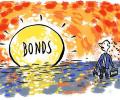
Banks looking to raise capital via bond sales to fund decade-high credit growth were compelled to put some of these debt issuances on hold amid a sharp rise in yields since late September, sources told Business Standard. A major private lender, Axis Bank, has not yet followed through with a planned issuance of infrastructure bonds worth around Rs 3,000 crore. This is because volatility in the bond market in late September led to investors seeking higher yields, sources said.

Javier Ceppi, tournament director of the FIFA Under-17 World Cup to be hosted by India next year, expressed his happiness about the way things were moving ahead in the preparation of the tournament.

The external environment has worsened further. While the Finnish economy entered into a recession, Swedish economic growth also dipped. The Finnish gross domestic product (GDP) dropped 0.6 per cent in October-December, 2022. It was the second quarter of negative growth, which is a technical definition of recession.

One-sponsor-one-fund rule may set off merger as Amundi seen sponsoring two funds following buyout.
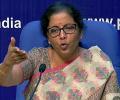
In the biggest consolidation exercise in the banking space, the government on Friday announced four major mergers of public sector banks, bringing down their total number to 12 from 27 in 2017, a move aimed at making state-owned lenders global sized banks.

The RBI rejection is a second blow to BoB - the lead bank of both companies -- after a Delhi high court order on August 18 stayed a move by BoB and the entire consortium of lenders to classify these accounts as fraud, restraining them from taking any other coercive action till the next hearing.

This may come as a surprise to many. Retail price inflation in petrol was the lowest at 10.21 per cent in March since November 2020. In diesel, it scraped the bottom of the barrel at 5.19 per cent in the last month of 2021-22 since February 2020. Even liquefied petroleum gas (LPG) was at a nine-month low of 9.97 per cent in the month.

The cases pertain to State Bank of India, Punjab National Bank, Andhra Bank, Oriental Bank of Commerce, Indian Overseas Bank, Allahabad Bank, Canara Bank, Dena Bank, Punjab and Sind Bank, Central Bank of India, Union Bank of India, IDBI Bank, Bank of Baroda, Bank of Maharashtra and Bank of India.
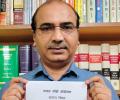
A video showing anti-Muslim slogans being raised during a protest at Jantar Mantar here was widely circulated on social media, following which the Delhi Police registered a case in connection with the matter on Monday.

India's equity markets are on a roller-coaster ride, after delivering spectacular returns for two consecutive years - in 2020 and 2021. The benchmark National Stock Exchange's (NSE's) Nifty50 is down 1.5 per cent in the first nine months of the current calendar year 2022 (CY22) as foreign portfolio investors sold Indian stocks due to rising bond yields in the US and across global markets, including India. The sell-off in the Indian equity markets has, however, not been broad-based and largely limited to sectors facing earnings headwinds from rising interest rates, lower commodity and energy prices, and likely economic recession in advanced economies.

The Securities and Exchange Board of India (Sebi) has just released a proposal to alter the regulations pertaining to the sponsor system for mutual funds. One of the reasons for the proposed changes is that there are two conflicting regulations that need to be clarified. The other reason is that the sponsor system may itself be outdated as it stands, and the proposed changes would allow new entities such as private equity funds and portfolio management services to enter this space.

Investors and companies should brace for higher commodity prices over the next few weeks in the backdrop of Russian troops attacking Ukraine on Thursday. Meanwhile, US President Joe Biden threatened new sanctions against Russia for an act of aggression against Ukraine. All this, analysts believe, can push prices of key commodities such as crude oil, ammonia, urea, potash, and phosphates higher.

Besides, the Australian regulator had issued licence to the bank, paving the way for it to open an office there, Bank of Baroda chairman and managing director M D Mallya said.

Dubai-based billionaire BR Shetty has sued Bank of Baroda (BoB) and audit firm Ernst & Young (EY) in a New York court, accusing them of ignoring fictitious and fraudulent transactions that resulted in NMC Healthcare going bankrupt. Shetty is seeking $8 billion in damages in the suit that also names the top management of NMC Healthcare, and Netherlands-based Credit Europe Bank. A top NMC Healthcare official confirmed the development to Business Standard and said despite several meetings, senior BoB officials in India did not take remedial steps for fear of getting involved in an international ponzi scheme perpetrated by then senior management officials.

As the Indian currency hovers around its lowest versus the US greenback, several smaller and mid-sized companies are expected to face rough weather as almost 44 per cent of the foreign loans taken by Indian companies remained unhedged. According to the data sourced from the Reserve Bank of India, Indian companies raised around $38.2 billion in the financial year ended in March. Of this, only 56 per cent of the loans are hedged while the rest of the foreign loans remain unhedged, thus risking the companies to forex volatility.

NPA problem to continue for next 2-3 quarters: banks to FinMin

The ministry of finance on Tuesday clarified that public sector banks (PSBs) have intimated they are not going to raise bank charges in the near future in view of the COVID-19 pandemic. The ministry's statement comes after several media reports citing steep increase in service charges by certain PSBs surfaced. No service charge is applicable on the 60.04 crore Basic Savings Bank Deposit (BSBD) accounts, including 41.13 crore Jan Dhan accounts opened by the poor segments of the society, as per the statement.
